


News
Private Label Setting Powder Manufacturer 2026 Soft-Focus Guide
-
 author
A setting powder can look excellent in a development sample and still become a difficult product after launch: too dry after several hours, visible under flash, poorly matched to the target shade range, or messy after long-distance shipping. Those risks are especially relevant to 2026 launches built around blurred skin, soft-focus complexion products, and a more natural “modern matte” finish.
For a private label buyer, the job is not to copy the trend. It is to turn it into a formula, shade plan, package, and production brief that can be tested and repeated in bulk. Mocoallure’s OEM/ODM powder makeup range gives brands, importers, and distributors a starting point for powder projects.
How Blurred Skin Changes a Private Label Setting Powder Brief
“Blurred” works in campaign language, but it is too broad for product development. One brand may want light shine control; another may expect stronger oil management and a smoother look. Defining the result early makes samples easier to compare.
Soft Focus Is a Performance Target, Not Just a Claim
A soft-focus setting powder needs balance. Too little setting performance can make it feel decorative rather than useful. Push mattifying too far and the finish may look dry, flat, or more obvious around expression lines.
A stronger brief uses practical terms: natural matte rather than flat matte, controlled shine rather than maximum oil absorption, low visible buildup, and comfortable touch-ups. Climate matters too. Humid markets may call for more oil control, while cooler or drier markets may place more value on comfort.
When Green Setting Powder Makes Commercial Sense
Green setting powder is one of the more visible 2026 color-correcting directions, combining powder setting with redness correction. It can create a useful point of difference, but only where the target customer has a clear need.
A retailer already selling color-correcting products may have a natural place for a green SKU. A newer brand with limited inventory may get more value from a strong translucent or tinted powder first.
If the demand case is clear, the next decision is format: loose or pressed.
Loose or Pressed Setting Powder: Which Format Fits the Project?
Format affects application, packaging, freight risk, and retail positioning. Settle this choice before artwork and component decisions go too far.
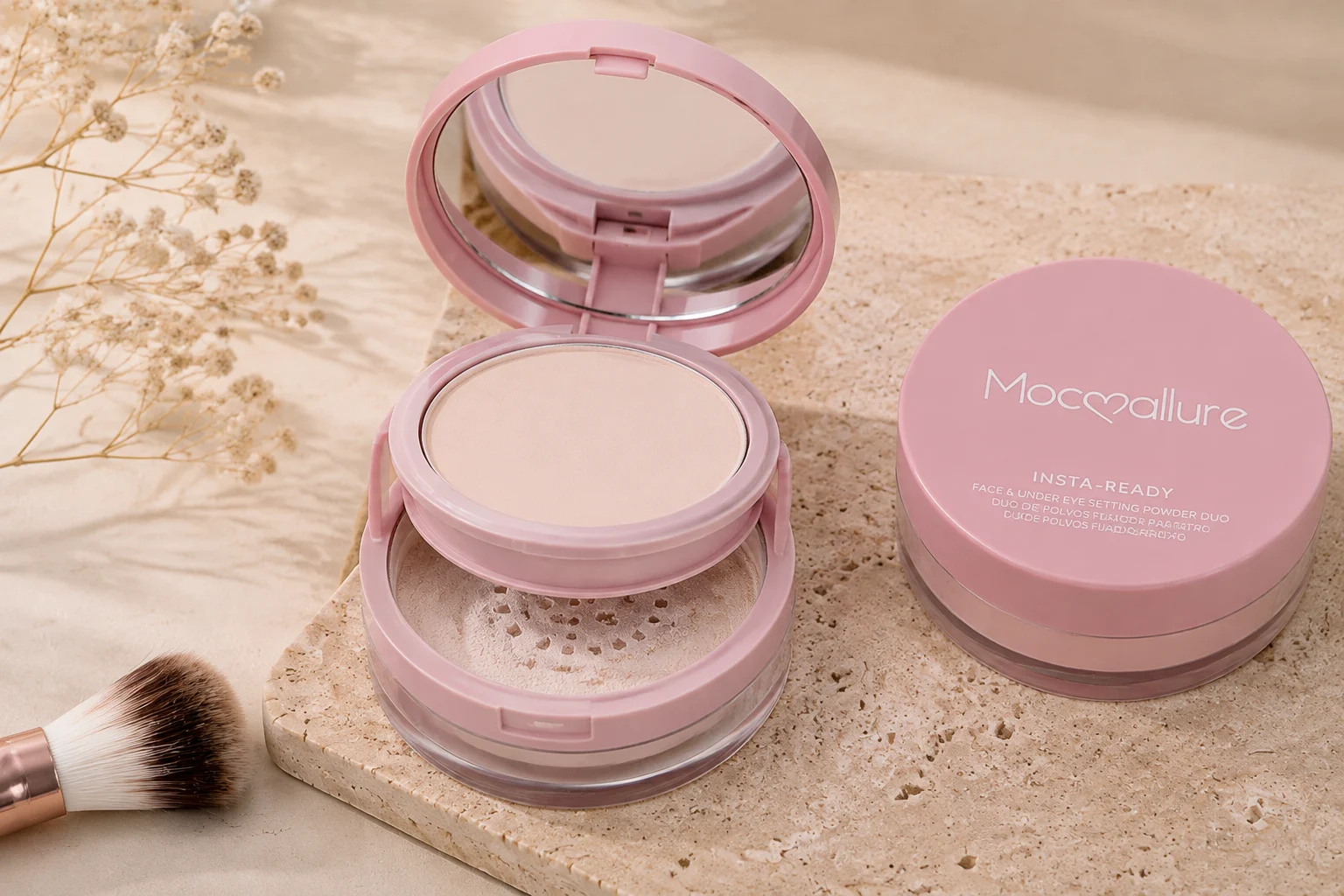
Loose Setting Powder for Controlled Application
Loose setting powder fits targeted setting, baking, and shine control. Jar size, sifter or mesh, closure, fill level, and applicator all affect daily use.
For export orders, leakage deserves attention. Fine powder can work through a poorly matched closure during long-distance transport, leaving the customer with a dusty carton despite an acceptable formula.
Pressed Setting Powder for Portability and Touch-Ups
Pressed setting powder is easier to carry and suits quick touch-ups. Pressing quality becomes part of product performance. A cake pressed too hard may give weak pickup; one that is too fragile may crack after international shipping.
Either issue can generate complaints even when the formula performs well. Once the format is fixed, formula performance becomes the next buying decision.
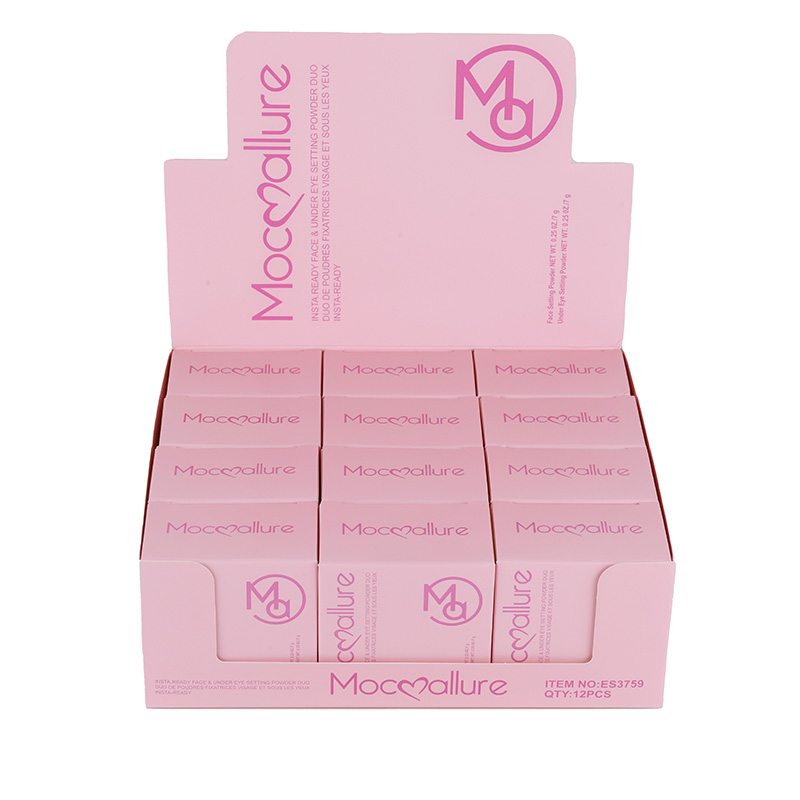
Brands can review Powder-ES3759 as a setting powder duo and packaging reference before discussing the finish, shade direction, and packaging required for their own project.
Which Setting Powder Specifications Actually Matter?
For most OEM setting powder projects, a small group of factors matters more than a long claim list: texture, oil control, caking, shade behavior, white cast, flashback, and compatibility with common base makeup.
Texture, Oil Control, and Caking
Hand swatches alone reveal very little about real wear performance. Test the sample over the type of foundation or skin tint the target customer is likely to wear, then check it again after several hours. The T-zone, dry areas, and expression lines usually show whether the balance is right.
Oil-control targets need context. Stronger absorption can be useful in humid markets, but excess mattifying may make dry areas more visible. A clear RFQ links performance to skin type, climate, and wear expectations rather than simply asking a setting powder manufacturer for the “strongest” formula.
Shade Range, White Cast, and Flashback
“Translucent” does not mean invisible on every complexion. A powder may disappear on one skin tone and look pale or gray on another. Direct photography can reveal flashback, where the face appears noticeably lighter under flash.
That matters for creator campaigns, livestreams, and photography-heavy e-commerce. Test the planned shades on relevant skin tones under daylight, indoor lighting, and direct flash.
More shades can improve market fit, but every SKU adds forecasting and inventory. A focused range with steady sell-through can be stronger than an oversized launch range.
With performance and shade strategy defined, customization becomes easier to control.
What Can Be Customized in a Private Label Setting Powder Project?
Customization may cover formula direction, finish, shades, packaging, branding, and sample revisions. Full customization sounds attractive, but few projects need every element redesigned.
Formula and Finish Customization
An established brand may come with a benchmark powder and precise targets. A newer project may benefit from a simpler starting point.
A benchmark product makes the conversation concrete: perhaps the finish is right but feels too dry, or the texture is good but the shade direction needs work. A custom formula makes sense when there is a specific performance gap to solve, not simply because “custom” sounds more premium.
Packaging, Shade Options, and Cost Trade-Offs
Unit price is only one part of project cost. Formula changes, shade count, packaging, printing, sample revisions, and order volume all affect the investment.
Standard components can keep a launch straightforward. More customized packaging adds approvals and production steps, while a larger shade range ties up more stock.
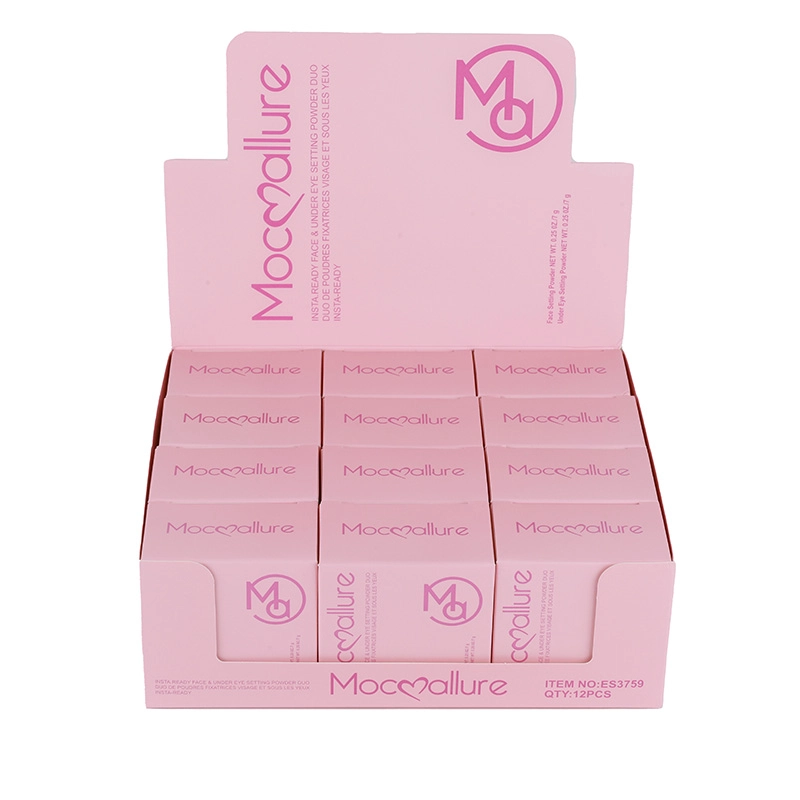
Those choices have to be proven in a physical sample. Before a purchase order is placed, the question changes from “What do we want?” to “Does the finished product deliver it?”
How to Evaluate Setting Powder Samples and Suppliers Before Bulk Production
Sample approval turns a promising concept into a purchasing decision. The powder needs to work in realistic conditions and remain reproducible in bulk.
Test the Finished Product Under Real Use Conditions
A practical private label setting powder review can cover:
- Pickup and spread
- Soft-focus finish in different lighting
- Oil control after normal wear
- Caking around dry areas and expression lines
- White cast and flashback on relevant skin tones
- Loose-powder leakage or pressed-powder breakage
Keep the approved sample as a benchmark for shade, texture, fill, packaging, and overall appearance.
Compare Development Capability, QC, and Reorder Stability—not Only Unit Price
A setting powder manufacturer is easier to evaluate when the discussion covers development, sampling, packaging coordination, quality control, production planning, and repeat orders.
Mocoallure operates a production facility of about 5,000 square meters and works with powder plus oil-and-wax color cosmetics. Its published manufacturing information includes GMPC dual certification, ISO 22716, formula development, package design, and mass production.
Buyers who need more detail on factory checks, samples, and bulk scheduling can use Mocoallure’s OEM/ODM factory guide as a separate sourcing reference.
Treat lead time as two timelines—sampling and bulk production—because revisions, shades, packaging, printing, approvals, and order volume can move either one.
Conclusion
Blurred skin gives setting powder a timely 2026 story, while private label setting powder remains an evergreen sourcing category. Products that hold up after launch usually have the right finish, workable oil control, suitable shades, low flashback, practical packaging, and repeatable production.
Brands, importers, distributors, and private label buyers developing a loose or pressed powder can contact Mocoallure for an OEM/ODM quotation. Sharing the target finish, format, shade direction, packaging idea, estimated quantity, destination market, and preferred launch timing gives the project a clearer start.
FAQ
Q1: What information do I need to send to a private label setting powder manufacturer?
A: Include the target finish, format, shade direction, oil-control needs, packaging idea, expected quantity, destination market, and launch timing. A benchmark product can make formula discussions more precise.
Q2: Is loose or pressed private label setting powder better for a beauty brand?
A: Loose powder fits controlled setting and oil management; pressed powder is more portable for touch-ups. The better format depends on customer habits, sales channel, packaging budget, and transport conditions.
Q3: What affects the cost and MOQ of a private label setting powder?
A: Formula route, shade count, packaging, printing requirements, and order volume can affect MOQ and total project cost. Additional sample revisions may also add development time or cost.
Q4: How do I test a private label setting powder sample before bulk production?
A: Check pickup, texture, oil control, caking, white cast, flashback, and wear over realistic base makeup and relevant skin tones.
Q5: How long does an OEM setting powder project take?
A: Timing varies with formula revisions, sample rounds, shade count, packaging availability, printing, and order quantity. Confirm sampling and bulk-production schedules separately.

our best Product
Product We’re Offering
call emergency
+86 18767932113

get in touch
How May We Help You!

our testimonials
What They Say About Our

We’ve been wholesaling beauty products from this supplier for 2 years, and the quality has never disappointed!