


News
27
August
Private Label Highlighter Guide 2026 for Beauty Brands
-
 author

The return of sculpted cheeks, visible shimmer, and full-glam makeup is shaping highlighter development in 2026. Yet buyers are not simply bringing back the intense metallic finishes of 2016. Current demand favors finer pearl, smooth brush pickup, buildable payoff, and shades that remain flattering under daylight, retail lighting, and phone cameras.
For beauty brands, importers, distributors, and wholesalers, this creates a timely private label highlighter opportunity. It also raises practical sourcing questions. A strong finger swatch may perform poorly with a brush, leave an ashy cast on deeper skin, develop hard pan, or crack during export shipping.
Before placing a bulk order, buyers need to review the format, finish, shade range, pressing quality, packaging MOQ, sample controls, and the manufacturer’s ability to reproduce the approved product consistently.
Why the 2016 Makeup Revival Matters for Highlighter Brands
Bold, expressive makeup gives highlighter brands an entry into current beauty conversations. The product brief still needs a defined customer, sales channel, and price level so the range can sell beyond one trend cycle.
Keep the Nostalgia, Update the Finish
The old “blinding highlight” can inspire campaign visuals, but a direct copy may narrow the customer base. In 2026, shimmer is returning in more polished, wearable forms, while 2016-style makeup is coming back with softer execution rather than a strict recreation of the original look.
For a powder highlighter, that often means fine pearl, controlled reflect, and buildable payoff. Test each sample with a brush and a fingertip. Finger pressure can make a dry formula look smoother and brighter than it performs in normal use.
Define the Customer Before Choosing the Glow
A youth-focused online brand may want a strong metallic finish. A mass-market line may sell better with champagne, soft gold, and rose gold. Professional buyers may need several undertones and dependable layering.
Give the highlighter manufacturer a specific brief. “Luxury glow” leaves too much room for interpretation. “Fine champagne pearl, medium brush pickup, no large visible glitter” gives the development team a practical target.
Choose the Right Highlighter Format and Finish
Format affects stock exposure, packaging MOQ, retail price, and sample workload. A single compact, duo, or multi-shade palette can all work, but they suit different launch plans. Settle the format before artwork and packaging costs start to build.
Single Pan or Multi-Shade Palette
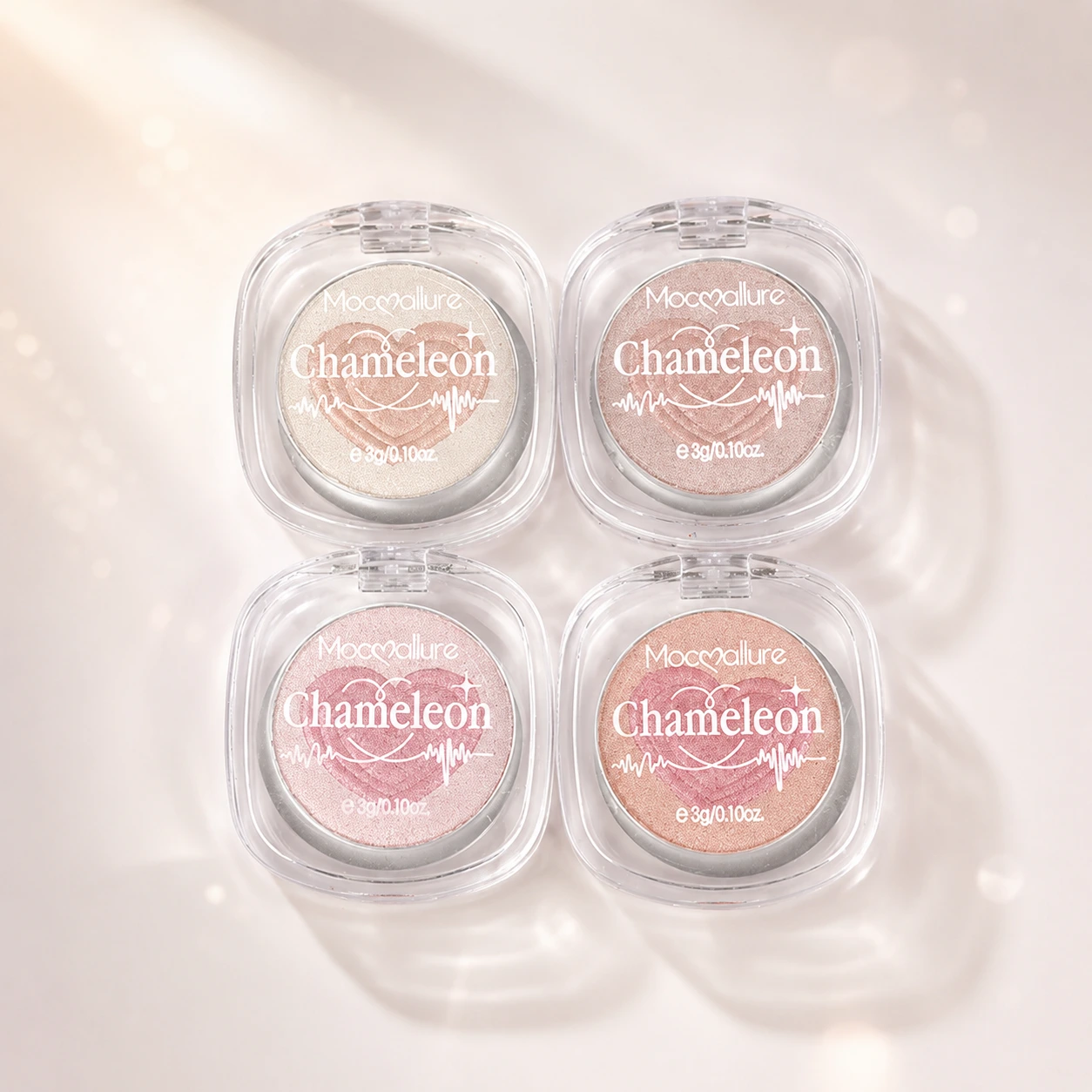
Single-pan compacts are easy to photograph, price, stock, and reorder. Mocoallure’s Highlight-3855 powder highlighter is a useful reference for brands considering a straightforward private label format with product, packaging, and logo customization.
Duos and palettes can offer wider shade coverage, but they create more shade references and inventory decisions. For a new brand with a limited stock budget, two or three single shades may carry less risk than one large palette.
Soft Glow, Pearl, or High-Impact Reflect
Soft glow suits daily makeup. Pearlescent finishes add dimension without a sharp metallic line. High-impact reflect can suit creator campaigns or seasonal drops.
The brightest finish is not always the best seller. A pale base may look gray on deeper skin, and excess visible powder can emphasize texture. The Colorful Bubble Highlight ES5108 provides a different pressed design reference for brands exploring a more decorative presentation. Final color, finish, packaging, MOQ, and testing scope still need project confirmation.
Build a Shade Range and Approval Standard
Shade planning takes time because pan color, applied color, and reflected light are not the same. Digital references hide undertone and particle behavior. Physical samples and clear approval records keep the buyer and factory working from the same standard.
Plan Around Skin Depth and Undertone
An opening range may include champagne, soft gold, rose gold, bronze, or copper. The mix depends on the customer, market, and retail price. Each extra shade adds sampling work, stock exposure, and reorder decisions.
Test the base color as carefully as the shine. For products intended for several markets, review samples on more than one skin depth instead of relying on one arm swatch.
Test in Real Selling Conditions
Apply the product over the foundation or powder your customer is likely to wear. Check it in daylight, indoor light, phone video, and flash. Review:
- Brush pickup and one-layer payoff
- Blendability and fallout
- White or gray cast after blending
- Surface change after repeated use
- Pan cracking during normal handling
- Compact closure and pan fit
Keep the approved formula version, shade code, pan size, fill specification, compact model, and artwork together. The right shade in an unstable pan is still the wrong product.
Select Packaging That Fits the Product Positioning
An approved powder still needs a compact that protects the pan, fits the target price, and survives export handling. Packaging affects perceived value, freight, breakage, and cash flow, so appearance must be weighed against MOQ and lead time.
Match the Compact to the Price Level
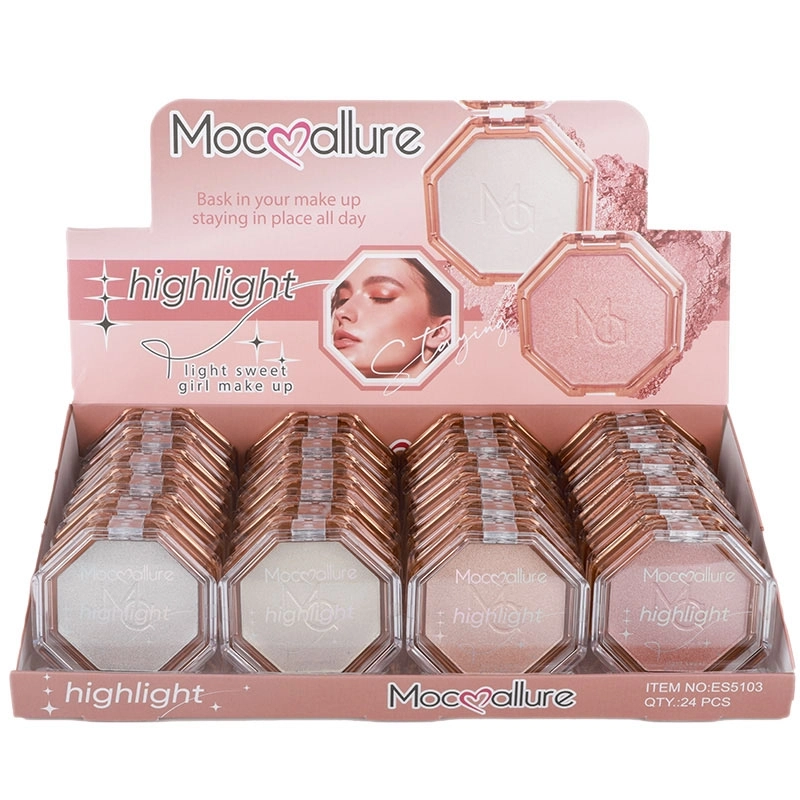
Clear-lid compacts make the shade visible and work well for accessible retail or wholesale displays. Mirrored cases can support a higher price point. Distinctive shapes improve shelf recognition when decoration and carton protection remain practical.
The Octagonal Highlighter ES5103 offers a packaging reference for a shaped compact and private label customization. Use listed products as a starting point; one configuration will not fit every order.
Check Shipping Protection and Packaging MOQ
Ask how the pan sits inside the compact and how finished units are packed for export. Review closure strength, hinge movement, outer-box fit, and master-carton protection.
Packaging MOQ needs separate review from formula MOQ. A stock compact with custom logo application may suit a test launch. Fully customized components or tooling usually make more sense when forecast volume can support the added cost and lead time.
Compare Highlighter Manufacturers Before Bulk Production
Compare factories only after the formula and packaging brief is fixed. Similar quotations may cover different specifications. A reliable powder highlighter manufacturer should show how the approved sample is linked to the formula, shade code, pan specification, component, artwork, and production record.
Verify Sample-to-Bulk Consistency
Keep one sealed or clearly coded approval sample. Confirm the matching formula version, shade, finish, pan specification, compact, logo method, label, carton, and packing method before production starts.
Every material change needs a new version. A revised pearl level, pressing strength, or compact may affect pickup, appearance, and breakage risk. Mocoallure’s OEM makeup sample QC guide provides a practical reference for checking texture, shade, packaging, and the final approved sample before a bulk order.
Compare Total Project Cost
A low unit quote can become expensive after repeated samples, component changes, weak cartons, or replacement stock.
| Checkpoint | Why it matters |
| Formula and shade traceability | Links the approved sample to bulk production |
| Pan hardness | Affects pickup, cracking, and shipping loss |
| Packaging MOQ | Shapes stock exposure and cash flow |
| Lead time | Protects the launch calendar |
| Batch-to-batch consistency | Supports repeat orders |
| Technical response | Keeps approvals moving |
Choose the specification that fits the customer, channel, inventory budget, and reorder plan—not simply the most dramatic swatch or the heaviest compact.
How Mocoallure Supports Private Label Highlighter Projects
Mocoallure is a private label makeup manufacturer focused on powder and oil- or wax-based color cosmetics. Its range includes highlighter, blush, eyeshadow, eyebrow products, powder, and makeup sets. The company operates a 5,000-square-meter facility and supports formula development, packaging design, sampling, and mass production for OEM/ODM projects.
Prepare a Clear RFQ for Formula and Packaging Review
A useful RFQ includes the target market, customer position, finish, shade references, compact style, logo method, quantity, target price, launch date, and document requirements.
Reference photos help, but a written brief removes guesswork. “Single pressed pan, soft-gold pearl, medium brush payoff, no large glitter, clear lid, logo on top” gives the factory enough detail to review formula and packaging options.
Coordinate Formula, Packaging, and Bulk Approval
Approve the powder, shade, pan fill, compact, logo, label, carton, and packing method as one finished unit. A smooth formula can still fail commercially if the case opens in transit or the pan cracks during packing.
Mocoallure can review product and packaging within one custom highlighter project. Testing plans and available reports are confirmed according to the selected formulation and order requirements. Final claims, labels, notification, or registration remain subject to the destination market and the local responsible party.
Conclusion
The 2016 makeup revival gives highlighter makeup a strong traffic story, but buyers still need a product built for current customers. Shade fit, refined reflect, brush performance, pan strength, packaging MOQ, and batch-to-batch consistency decide whether the launch can move beyond its first campaign.
Brands, importers, distributors, and wholesalers planning a private label highlighter range can contact Mocoallure for a project review and quotation. Include the target market, finish, shade plan, preferred packaging, estimated quantity, target price, and launch date.
FAQs
Q1: Which private label highlighter format works for a first launch?
A: Single pans are often easier to price, stock, and reorder. Duos or palettes may suit projects with enough volume to support several shades.
Q2: What affects private label highlighter MOQ?
A: Formula choice, shade count, compact availability, logo process, carton printing, and the level of packaging customization can all affect MOQ.
Q3: What makes powder highlighter look chalky or ashy?
A: A pale base, mismatched undertone, excess visible powder, or weak blendability can create a chalky or gray result, especially on medium and deeper skin tones.
Q4: What needs approval before highlighter bulk production?
A: Approve the formula version, shade code, finish, pan hardness, compact, logo, label, carton, packing method, and coded reference sample.
Q5: What does a highlighter manufacturer need for a quotation?
A: Share the target market, finish, shade count, packaging, logo method, quantity, target price, launch date, and required testing or technical documents.

our best Product
Product We’re Offering
call emergency
+86 18767932113

get in touch
How May We Help You!

our testimonials
What They Say About Our

We’ve been wholesaling beauty products from this supplier for 2 years, and the quality has never disappointed!