

News
08
October
How to Plan a Private Label Powder Makeup Product With an OEM/ODM Manufacturer
-
 author
A private label powder makeup manufacturer should help you turn a product idea into a brief that can be sampled, reviewed, labeled, packed, and quoted.
For a brand planning blush, eyebrow powder, eyeshadow, or highlighter, the key decision is more than whether a supplier has a catalog. It is whether the supplier can explain the choices that affect texture, finish, color, packaging, market language, quality review, and production approval.
This guide gives buyers a practical way to prepare that brief and evaluate OEM/ODM responses without inventing specifications, MOQ, price, lead time, or regulatory approval.
Turn the Product Idea Into a Manufacturer-Ready Brief
Begin with the product’s commercial job: hero SKU, entry-price item, seasonal color story, replenishment product, or collection item. Define the buyer, channel, destination market, price position, and assortment role. These choices affect shade range, sampling, durability, and documentation.
Write a brief with separate requirements and preferences. Requirements might include a powder format, a language, a prohibited ingredient, a packaging constraint, or a market-specific label rule. Preferences may include finish, pan count, visual style, or reference texture. This prevents early ideas becoming fixed technical promises.
Choose the Right Powder Category Before Choosing the SKU
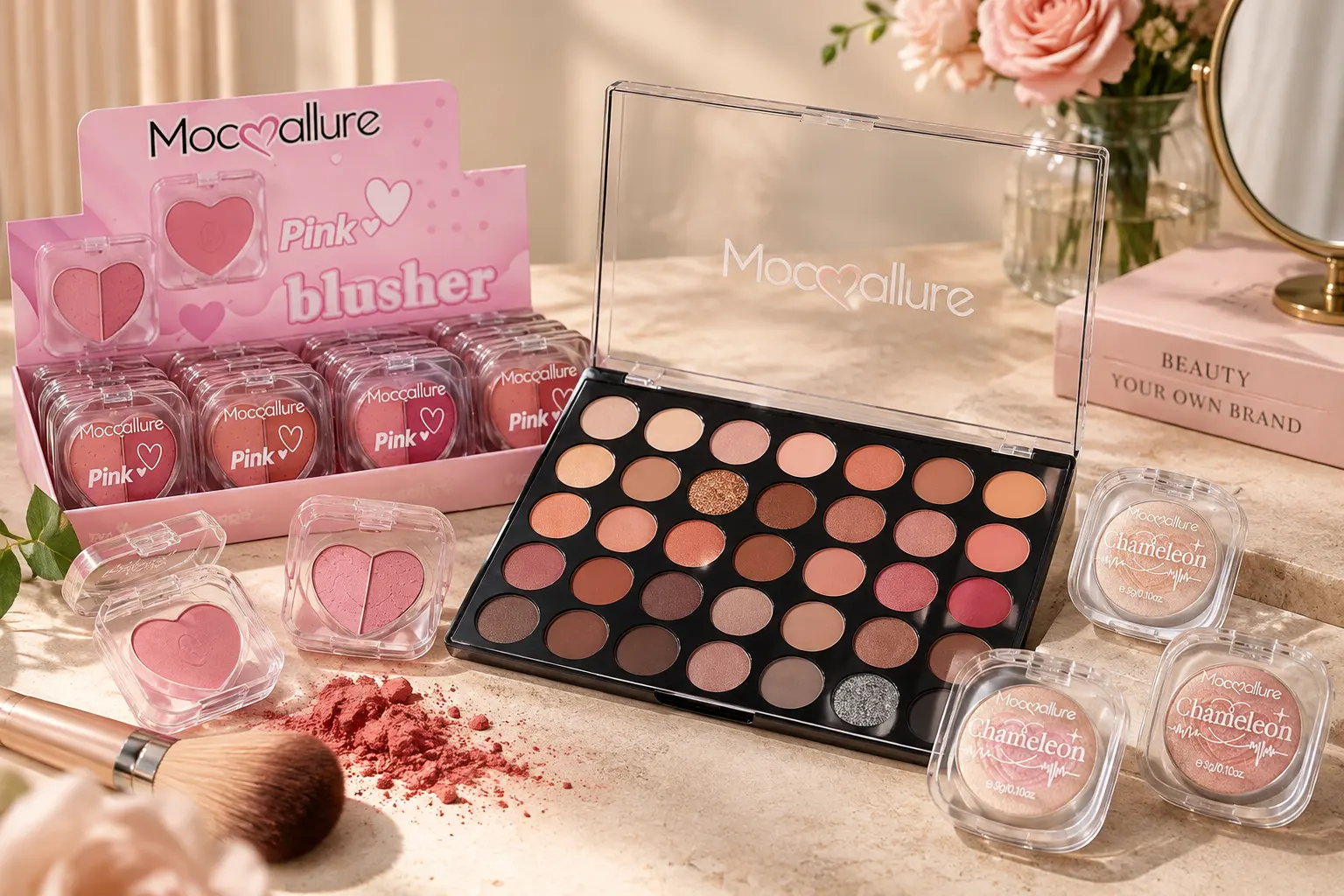
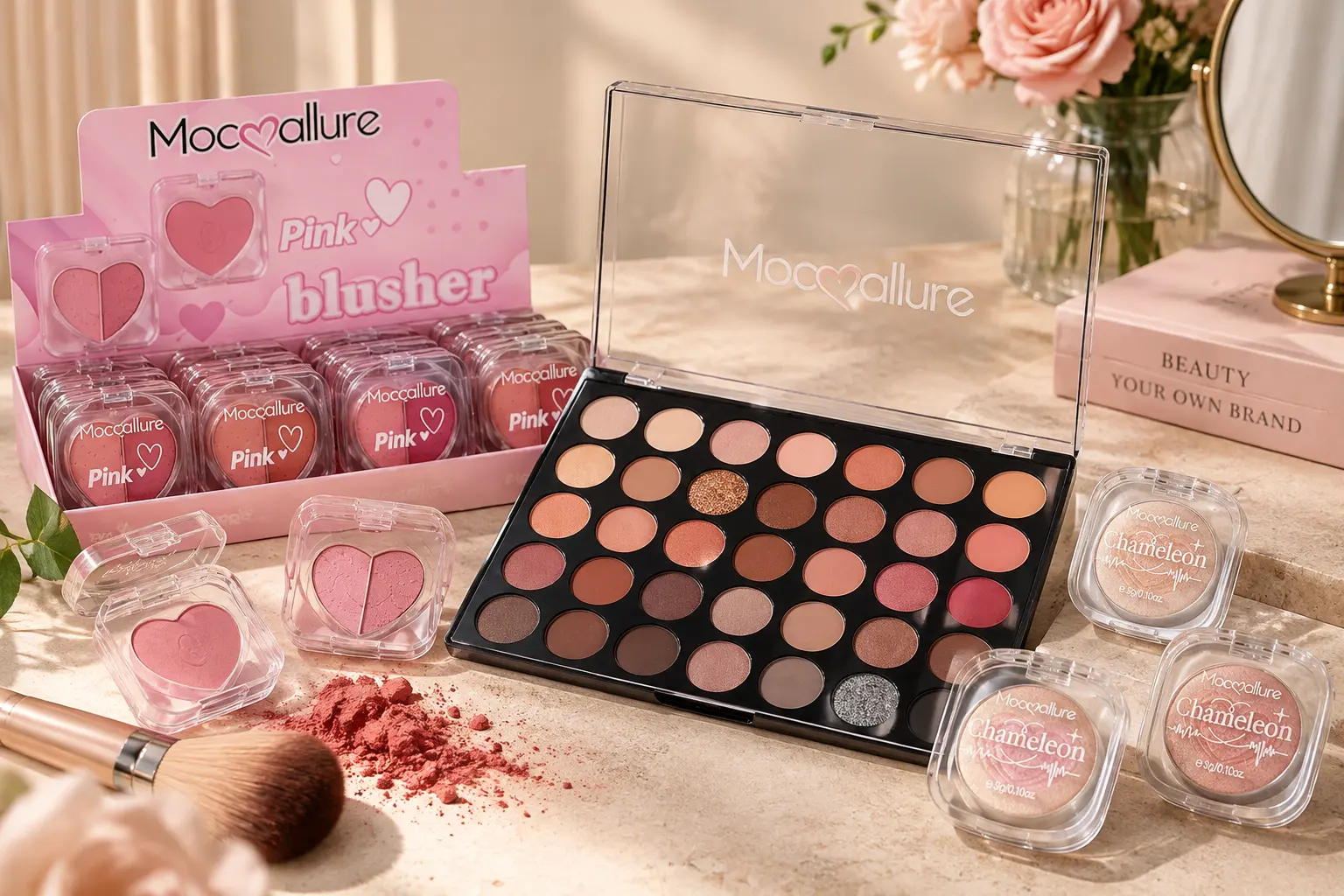
Mocoallure’s product structure includes blush, eyebrow, eyeshadow, and highlight categories, giving a powder makeup brief a starting point.
The categories are not interchangeable: blush is assessed for cheek color and finish, eyebrow powder for definition, eyeshadow for color and effect, and highlight for reflectivity and placement.
Use the blush powder category and related range pages to decide which customer job the first SKU must perform.
The brand describes fine or ultra-fine textures and finish directions including matte, pearlescent, micro-shimmer, and glitter. Use these to frame development, not skip sampling. Ask how the proposed finish will be evaluated. The connects formula development, packaging design, and mass production, so the brief can be reviewed as one project rather than as disconnected tasks.
A practical category rule is to select the product by the decision the end customer must make. If the customer needs natural cheek color, compare blush finishes and buildability. If the customer needs a compact eye look, compare shade logic, finish contrast, and palette usability. If the customer needs controlled definition, avoid forcing an eyeshadow brief to solve an eyebrow product problem.
Specify Finish, Shade Logic, and Use Conditions
Powder makeup projects are easier to develop when the brief defines the intended application result rather than only naming a trend. Describe whether the product should read as natural, soft-focus, luminous, high-impact, or occasion-led.
For a palette, explain the intended sequence or combination of shades. For a single pan, explain its role in the range. The manufacturer can then propose a sample set that answers a defined question.
Compare the eyeshadow powder category.
- Category and customer job: blush, eyebrow, eyeshadow, highlight, or another confirmed powder format.
- Finish direction: matte, pearlescent, micro-shimmer, glitter, or a proposed alternative to evaluate.
- Shade architecture: single shade, duo, coordinated palette, neutral story, colorful story, or market-specific range.
- Application expectation: soft build-up, visible payoff, blendability, or another result to compare in samples.
- Channel conditions: store shelf, e-commerce parcel, professional use, daily use, or occasion-led purchase.
- Claims and exclusions: only claims that can be supported and legally used in the destination market.
Do not approve a color system from a screen image alone. Record the reference, sample batch, lighting conditions, and approval comments. Color perception changes with substrate, lighting, skin tone, surrounding shades, and photography, so the final decision should be tied to a physical sample and a written shade reference where possible.
Plan Packaging and Artwork as Part of Development
Packaging affects usability, retail presentation, cost, and the number of technical decisions needed before production. Define whether the project needs a single pan, duo, palette, compact, or another format the manufacturer confirms. Consider mirror or applicator requirements only if they serve the channel.
For e-commerce, review closure strength and protection against powder breakage; for retail, review shelf visibility, handling, barcode area, and information space.
Review the highlighter powder category.
Keep artwork approval after the product identity and label content are stable. A working file should include product name, ingredients, net content, batch or lot information, expiry or period-after-opening information where required, responsible-party details, warnings, and destination-market language.
Mocoallure states that Arabic and English labeling can include product name, ingredients, Halal logo, and expiry date. That supports an early labeling question for buyers serving Arabic-speaking markets, but the brand owner or importer must still verify the exact local requirements and evidence.
Build a Sample Plan That Answers Decisions
Do not request a sample without a decision to test. Give each sample a job. One sample may test texture; another a finish; a third a pack route or shade combination. Record what changed between versions, what was approved, and what remains open. This prevents informal approval that cannot become a production instruction.
- Approve the product category and customer job.
- Compare formula or finish directions against the same evaluation criteria.
- Confirm shade names, references, and the visual logic of the set or palette.
- Review packaging fit, closure, information space, and handling risks.
- Check that the sample, artwork, label content, and commercial quote refer to the same version.
- Document final approval and list any evidence or market review still required before production.
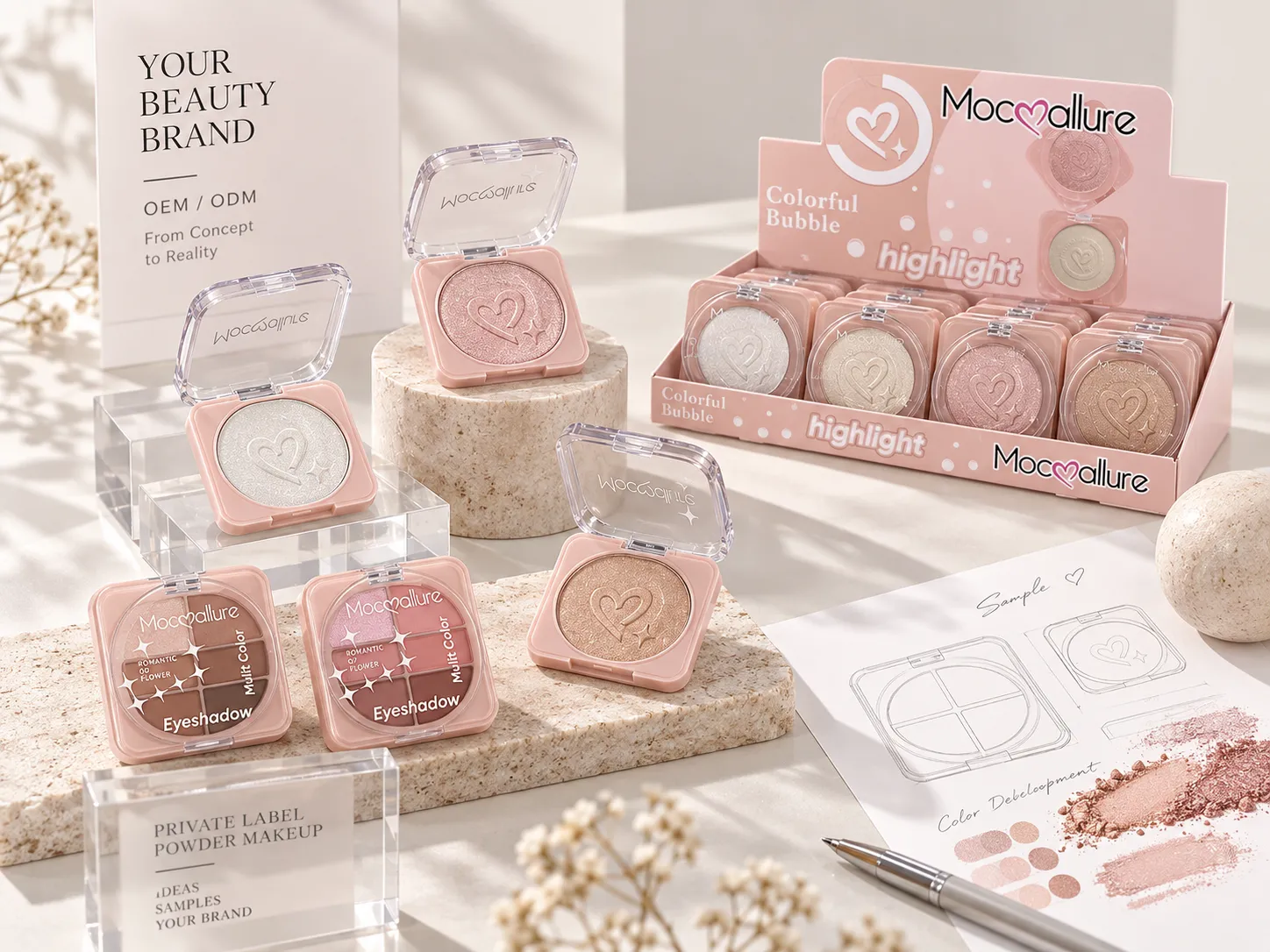
Mocoallure describes a full OEM/ODM path from formula development through package design and mass production. For a buyer, that makes version control especially important: product, pack, and artwork should be approved as a connected set. Ask the supplier to identify sample, packaging, and change references in the approval record.
Ask for Evidence Without Overstating Compliance
A development brief should request evidence that matches the market and product: raw-material and finished-product checks, stability, microbiological and heavy-metal review, and packaging checks. The exact set depends on formula, market, and importer responsibilities, so request confirmation rather than copying a generic checklist.
Mocoallure describes GMPC dual certification, ISO 22716, cosmetic GMP adherence, and whole-chain testing that includes microbiological, heavy-metal, and stability testing. These are useful points for supplier due diligence, but they should be verified for current scope and relevance.
Ask for the applicable certificates and reports, confirm who issued them, and have the responsible regulatory party assess whether they satisfy the destination market. Applicable certifications and test reports should be reviewed together with destination-market requirements.
Make the Commercial Request Comparable
Send one RFQ that keeps technical, packaging, and commercial questions distinct. Request the quote basis for formula, components, decoration, artwork, sampling, inspection, and shipping.
Ask what is included, optional, and price-changing. This makes supplier responses easier to compare and helps clarify assumptions before the project reaches artwork or mass production.
Review the one-stop OEM/ODM manufacturing service.
Do not publish or budget a fixed MOQ from general supplier language. Put the target quantity, repeat-order expectation, packaging setup, payment terms, lead time, and delivery basis into the inquiry and require a written response.
Adapt the Brief to the Target Market
A product intended for the Middle East may need a different language and documentation workflow from one intended for Southeast Asia or South America. Name the destination country and confirm language, claims, registration duties, import documents, and retailer requirements with the importer or local adviser.
Mocoallure describes export activity across the Middle East, Africa, South America, and Southeast Asia, plus development attention to hot, humid, and highly pigmented color directions. Treat this as a reason to ask market-specific questions, not as proof of a destination standard. Request relevant evidence and performance criteria.
Know When to Revise the Project Before Ordering
Revise the brief when the category, finish, shade story, and packaging are trying to serve different buyers. Revise the brief when a claim requires additional supporting evidence, when the sample needs further refinement, or when label space needs adjustment. A narrower first SKU with a clear approval test is easier to quote than a broad range with unresolved decisions.
Also resolve ownership. The brand owner should know who approves shades, who owns artwork, who supplies required legal text, who reviews documents, who signs the production sample, and who accepts finished-goods inspection. Clear ownership keeps regulatory and commercial decisions with the brand or importer.
Conclusion: Build the Brief Around an Approval Decision
A private label powder makeup project connects category, customer job, finish, shade logic, packaging, labels, samples, evidence, and commercial terms. Mocoallure’s verified powder categories and OEM/ODM path provide a starting point for blush, eyebrow powder, eyeshadow, and highlight. Send a structured brief, request evidence, and approve one defined version before expanding.
Request a Powder Makeup Development Review
Include the category, customer job, target market, finish, shade logic, packaging concept, label language, sample questions, and expected commercial conditions in your first message. Use the powder makeup development inquiry to ask Mocoallure what can be developed, what evidence is available, and which terms require a formal quotation.
FAQ
What products can be included in a private label powder makeup brief?
A brief can cover a confirmed powder category such as blush, eyebrow powder, eyeshadow, or highlight, as well as a coordinated set if the manufacturer confirms the format. Define the customer job and finish before choosing the SKU. Do not expand the brief into unverified product categories simply because they are common elsewhere in the market.
How many samples should a powder makeup brand request?
There is no universal number. Request enough versions to answer distinct decisions such as texture, finish, shade logic, and packaging. Each version should have a stated purpose and approval record. More samples are not better without clear criteria.
Can Mocoallure support packaging and formula development together?
Mocoallure describes one-stop OEM/ODM support covering formula development, package design, and mass production. Ask which services apply to your project, what the sample and approval steps are, and which packaging or formula details require separate confirmation. A project quotation is still required.
Does an OEM/ODM manufacturer guarantee local compliance?
No general guarantee should be assumed. The manufacturer may provide formula, label, quality, and production information, but local compliance can depend on the destination market, importer, claims, responsible party, and product file. Have the appropriate importer or regulatory adviser review the evidence before launch.

our best Product
Product We’re Offering
call emergency
+86 18767932113

get in touch
How May We Help You!

our testimonials
What They Say About Our

We’ve been wholesaling beauty products from this supplier for 2 years, and the quality has never disappointed!